


Nongkrong and the Art of Staying Put
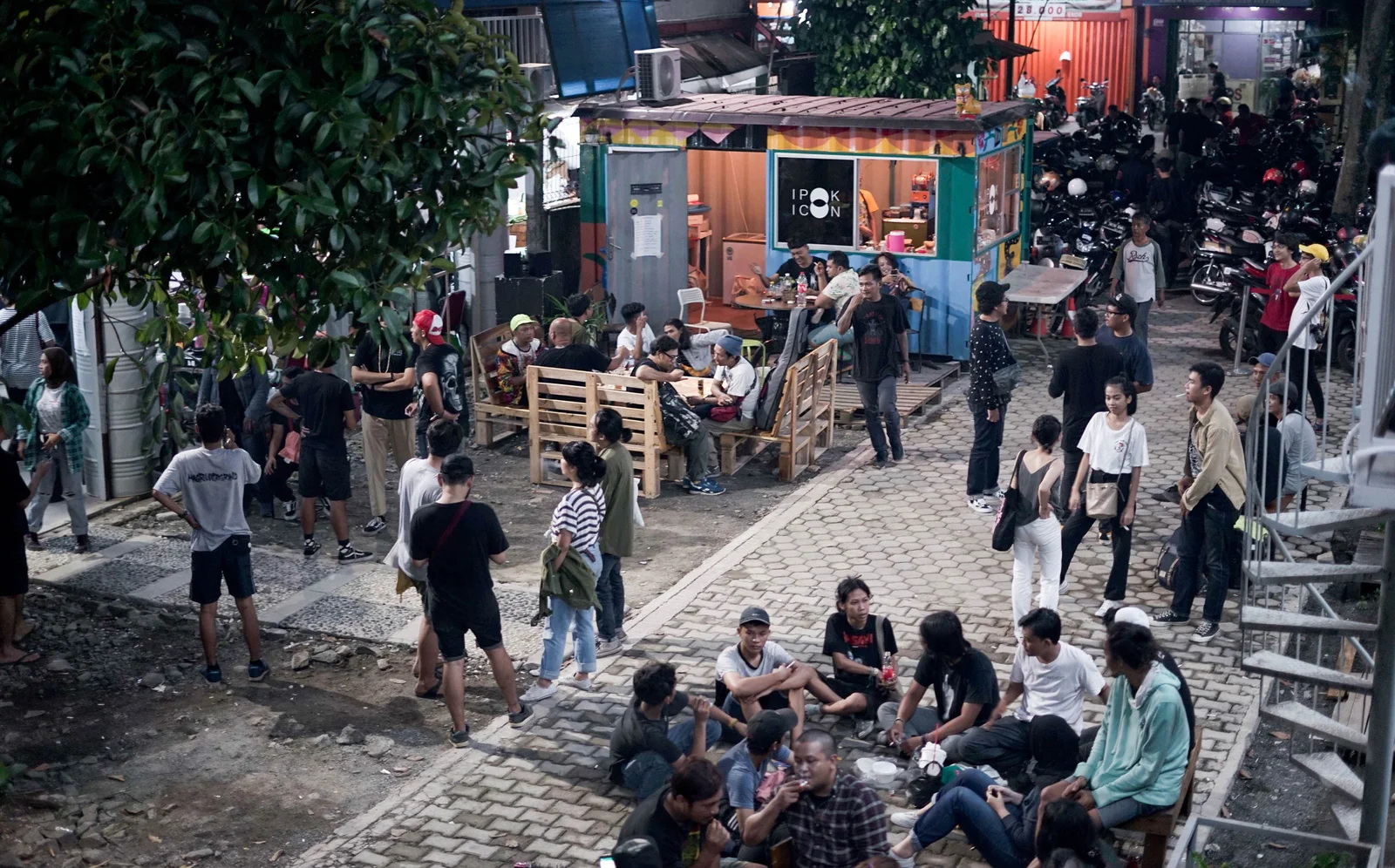
Nongkrong offers a quietly provocative philosophy of relation.
The Indonesian word is often translated simply as “hanging out,” but that translation barely grazes the surface. In the artist-run spaces of Yogyakarta, the city that serves as the hub for Javanese culture, nongkrong is the practice of spending time together without an overly determined purpose. It encompasses simple ideas like lingering in conversation and making space for trust and common ground to take shape. Running beneath the simplicity are subtle distinctions between experiences that are social but not performative, and of time that is unstructured but not empty.
Nongkrong presents a different worldview. It asks what might happen if value emerged from duration and spaciousness, focusing on the willingness to remain present long enough for something real to happen.
Presence Without Agenda
What makes nongkrong so compelling is that it dignifies a kind of time that contemporary systems often treat as waste. In the artist-run spaces of Yogyakarta, hanging out is actually part of the serious work. It’s where artists, organizers, neighbors, and thinkers gather without a strict program, and where ideas begin to circulate in less obvious ways. The conversation may drift. Someone may say something half-formed. A connection may emerge that no one could have predicted at the outset. Nothing may “happen” in the conventional sense — and yet, something essential is being built.
This is difficult for our productivity-driven culture to recognize. In contrast, nongkrong values creating conditions that enable things to happen on their own timetable. It understands that coherence, solidarity, and invention often require a field in which they can germinate slowly.
That has profound implications for branding. A brand is often understood as a system for shaping perception. But perhaps it’s more useful to think of it as a system for shaping conditions. Does it make people feel hurried, processed, and extracted from? Or does it create enough room for orientation, recognition, and return? Does it treat every interaction as a transaction waiting to happen, or does it understand that relationships are built in the spaces where no obvious transaction is taking place?
The Difference Between Engagement and Inhabitability
Contemporary branding is saturated with the language of engagement. We measure clicks, comments, shares, dwell time, retention. We ask how to capture attention and keep it. But attention, in this framing, often becomes something to harvest rather than something to care for.
Nongkrong offers a gentler and more demanding question: can people actually inhabit the space you’ve made? To inhabit something is different from merely passing through it. It speaks to ease and the ability to linger without being pressured into a next step. This idea of making space may be one of the most overlooked dimensions of branding: many brands know how to attract attention, but few know how to trust the value of lingering and becoming places people want to remain.
Meaning That Emerges, Not Meaning That Is Imposed
There is another lesson in nongkrong that feels particularly Otherwise. It champions creating conditions under which something can emerge. This is a useful counterpoint to much contemporary brand practice, which is often so tightly controlled that it leaves little room for live intelligence.
Nongkrong reminds us that meaning can also arise through looseness, suggesting that not all coherence comes from control. Some of it comes from spending enough time in a shared space that patterns reveal themselves. This is true of communities, and it is true of brands. A strong brand system understands that some of the most meaningful forms of connection can’t (and shouldn’t) be scripted in advance.
The Social Infrastructure of Belonging
In Yogyakarta, nongkrong functions as social infrastructure. It helps sustain networks of mutual support, artistic experimentation, and communal life. It keeps the ecosystem alive through repeated, low-stakes contact, often assembled through small acts of repeated presence.
Brands that aspire to “speak to community” often overlook this. They declare “belonging” before they have created the conditions that make belonging possible, speaking in the vocabulary of togetherness while building systems that leave no room for actual social ease. And ease, simple as it sounds, is far more radical than it first appears.
Against Perpetual Motion
We live in systems that increasingly conflate stillness with failure. To linger too long is to fall behind. To stay put is to risk irrelevance. Yet a brand that knows how to stay put understands there are many rich signs of life beyond motion. This is a lesson many brands need right now. Not endeavoring to solve every problem by doing more, speaking more, or moving faster, but by opting for holding space and continuing to show up.
This is harder than it sounds. It requires confidence without spectacle, structure without overdetermination, and a willingness to trust that value may be accumulating even when it doesn’t look dramatic. And it also requires patience, which may be one of the rarest strategic virtues we have.
The Brand That Knows How to Linger
In the end, nongkrong offers us a philosophy of relation that yields a kind of social oxygen. It asks us to reconsider what counts as valuable and productive, and imagine the spaces where people can remain long enough for meaning to arise.