


The Architecture of Becoming
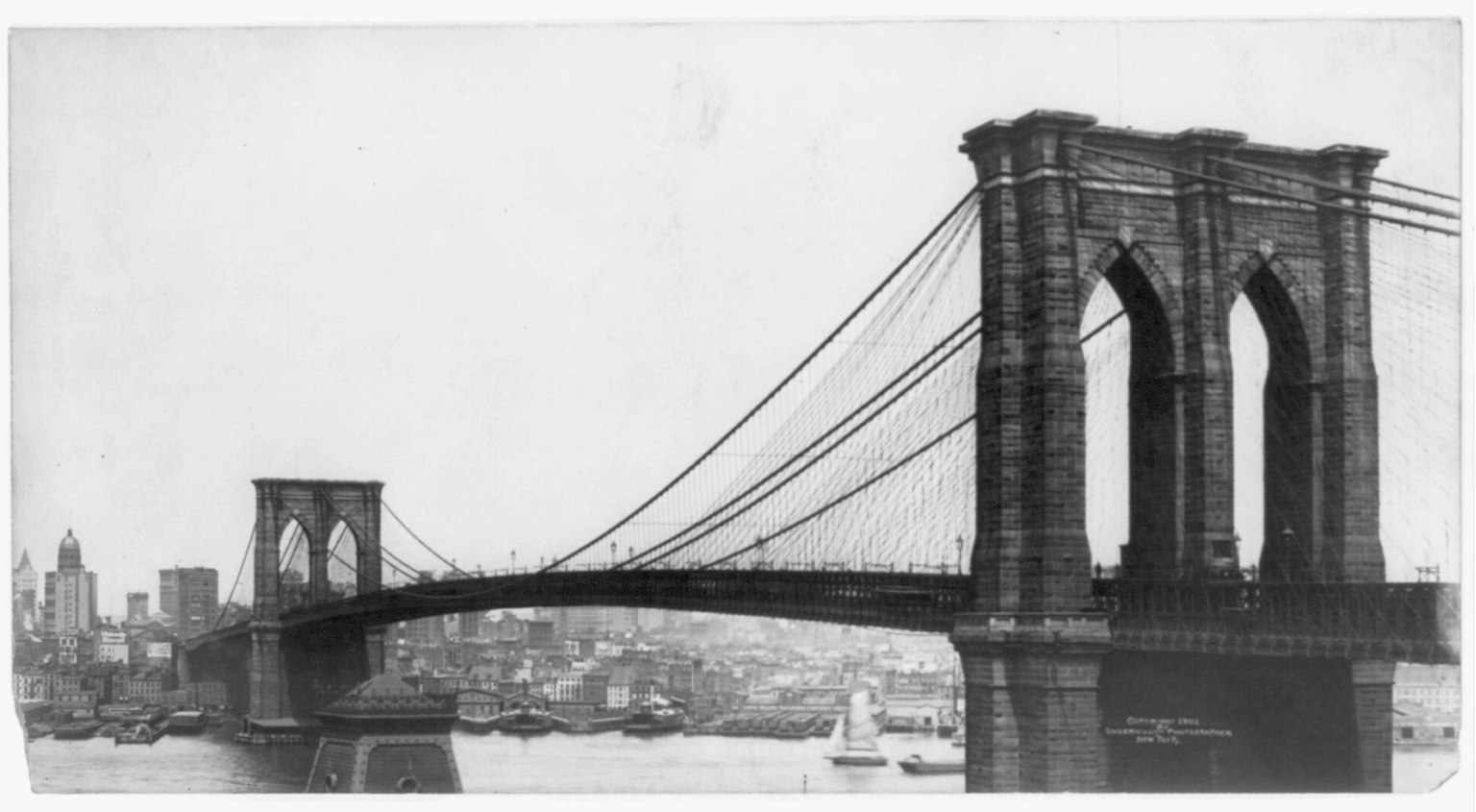
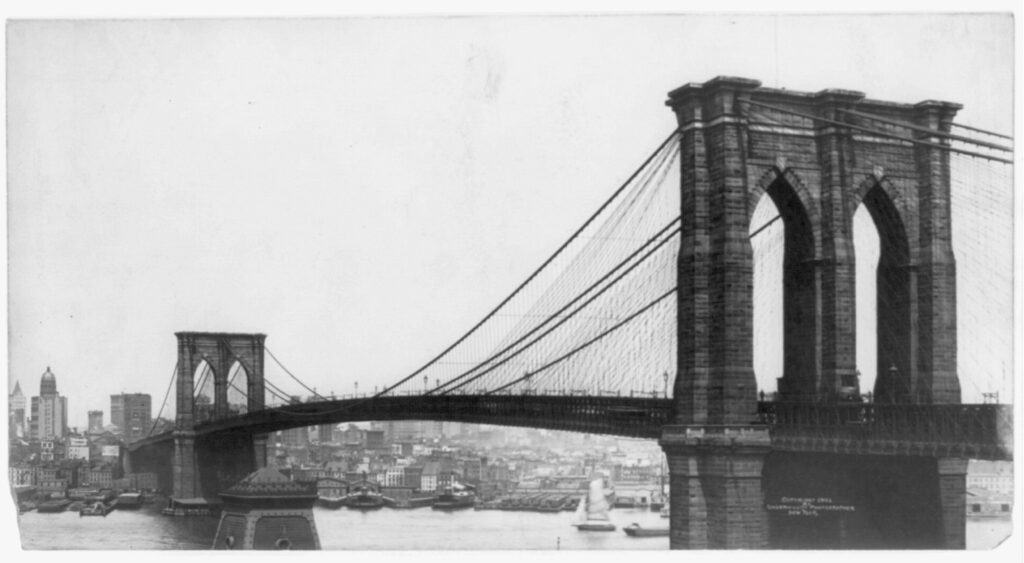
At Otherwise, we’re continually drawn to ideas that sit at the intersection of the engineered and the felt — systems that begin as structures and, over time, accumulate meaning. It’s in this spirit that we return to Hart Crane’s luminous meditation on the Brooklyn Bridge. Crane’s bridge begins as an object of steel and cable, then morphs into an act of cultural imagination, a structure that transforms engineering into symbol and function into feeling. In its sweep and suspension, Crane glimpsed something that remains deeply instructive for modern brand builders: meaning, at scale, must be architected.
Written in the early decades of the twentieth century, “To Brooklyn Bridge,” the prelude to Crane’s epic work, The Bridge, captures a moment when modernity was accelerating and America was renegotiating its relationship with industry, expansion, and speed. What makes Crane’s poem so enduring is that it senses something pulsing beneath the steel, beyond the bridge’s technical achievement. In Crane’s telling, the bridge is a field of energy. A vessel of collective meaning. A structure that vibrates with more than its material purpose.
This distinction matters, especially now.
We live in a world saturated with convoluted systems. Platforms, products, networks, and identities require us to move beyond questioning whether something works to questioning whether it resonates. Crane understood these ideas as they bubbled below the surface, recognizing that the most powerful structures hold tension between worlds, creating passage where there was once only distance.
He refers to the Brooklyn Bridge as a “terrific threshold,” and the phrase feels especially instructive. A threshold is never just a boundary. It is a site of transformation, a place where movement becomes meaningful. In Crane’s vision, by connecting Manhattan and Brooklyn, the bridge also connects the visible and the invisible, the human and the mythic, the present moment and something that feels almost eternal.
The most compelling brands behave in much the same way. At their most inert, brands function like signage: clear, efficient, and forgettable. But at their most alive, they begin to act more like Crane’s bridge by holding a field of meaning that people can feel. They become relational structures, not static artifacts, carrying motion within their stillness.
One of Crane’s most striking observations is his sense that the bridge contains “some motion ever unspent in thy stride.” It is a remarkable line because it captures something many engineered systems struggle to achieve: the appearance — and the experience — of aliveness. The bridge is fixed in place, yet it feels dynamically charged. It hums with stored potential. This is the difference between systems that function and systems that resonate.
In contemporary branding, there is often a tendency to over-optimize for consistency, legibility, and control. These qualities have their place, but when pushed too far, they can strip a brand of the very tension that makes it memorable. Crane’s bridge offers a different model. It is orderly, yes. Engineered with precision. But it is also expressive, atmospheric, slightly mysterious. It leaves room for projection, for imagination, for emotional interpretation.
Perhaps most importantly, Crane recognized that the bridge achieves something close to what Walter Benjamin would later describe as aura. Despite its scale and its industrial origins, the Brooklyn Bridge doesn’t feel infinitely reproducible. It feels singular in its presence. It commands attention through coherence and accumulated meaning, not through spectacle.
This is an increasingly rare quality in contemporary brand systems, many of which are built for frictionless replication. Yet the structures that endure and gather loyalty over time tend to preserve some measure of what Crane sensed so vividly: the ability to meet each encounter as if it were unfolding in the present tense. The bridge, after all, is crossed millions of times. And still, in Crane’s telling, it retains its charge.
There is another dimension of the poem that feels especially relevant to the Otherwise worldview. Crane repeatedly situates the bridge within a choreography of light — dawn, shadow, stars, acetylene sky — as though the structure is constantly being reinterpreted by the conditions around it. The bridge doesn’t change, but its meaning is never entirely fixed but instead endlessly animated by context and reshaped by perception.
Here, too, the metaphor deepens. Brands, like bridges, do not exist in isolation. They are experienced differently depending on cultural moment, audience state, technological environment, and emotional need. The most resilient brand systems are not those that resist this variability, but those designed with enough structural integrity and expressive flexibility to remain legible across shifting conditions.
Crane seemed to understand this instinctively. His bridge is both stable and alive. Both engineered and interpretive. Both fixed in form and fluid in meaning. Which brings us, perhaps, to the quiet provocation at the heart of the poem. Near the close, Crane offers a line that still feels electric nearly a century after it was written:
And of the curveship lend a myth to God.
It is an audacious suggestion that a human-made structure might generate mythic significance rather than merely inherit it. Yet this is precisely what the Brooklyn Bridge accomplished in Crane’s view. Over time, it transcended its function and entered the cultural imagination as symbol, as threshold, as promise.
For those of us thinking about the future of branding, the implication is both humbling and clarifying. The goal isn’t to build louder signals or manufacture more surface. The deeper ambition is to design visual, verbal, and experiential structures that can hold meaning long enough for resonance to accumulate. To create systems that, like Crane’s bridge, carry motion within stillness and coherence within complexity. Systems that do their job, certainly, but that also leave room for something harder to quantify and more difficult to engineer.
In the end, the lesson of Crane’s bridge is that great structures endure because they carry meaning and possibility with grace across the shifting distances of contemporary life.